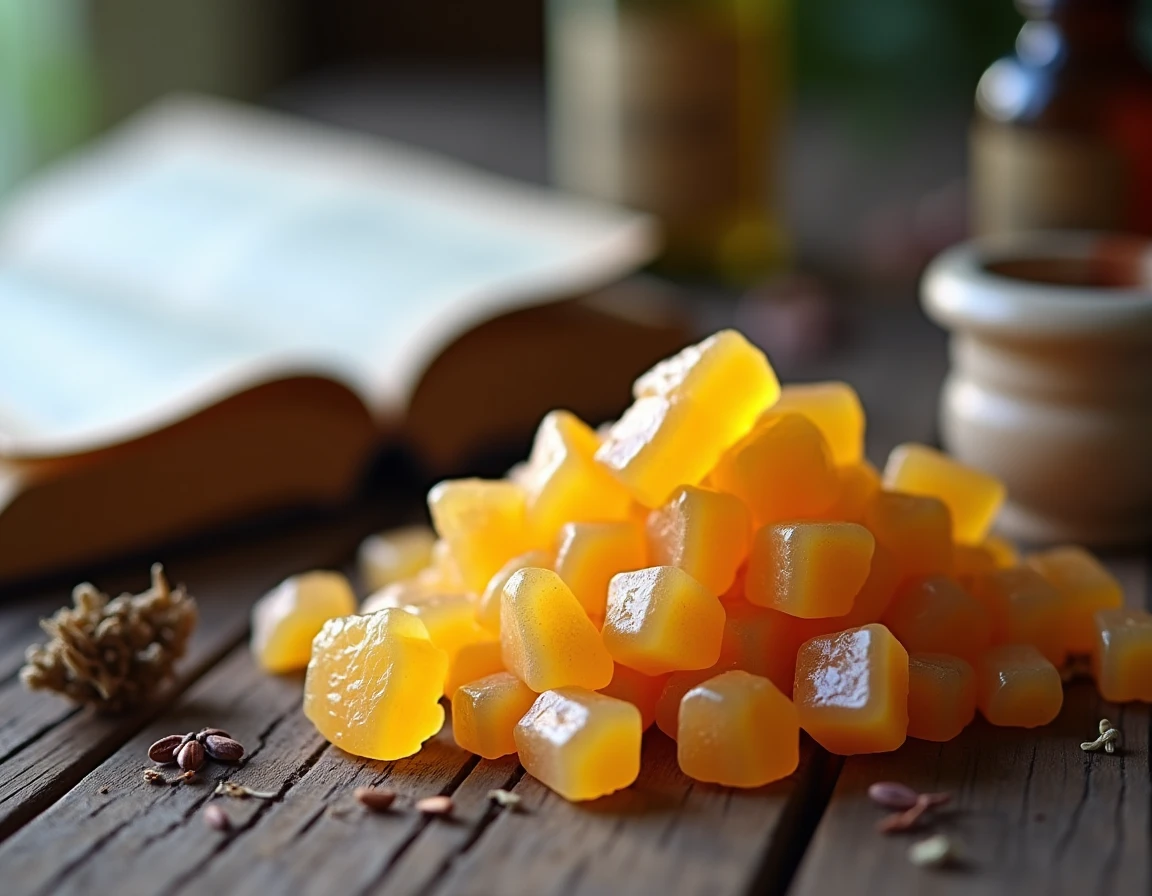
Guggul is an oleo-gum resin extracted from the tree Commiphora wightii, a thorny shrub native to India, Pakistan, and Bangladesh. Used for several millennia in Ayurvedic medicine under the name “guggulu,” this product is experiencing a resurgence of interest in France and Europe as a dietary supplement, particularly for lipid metabolism. Guggulsterones, its steroidal active principles, are at the center of discussions regarding its biological properties.
Standardization of guggul capsules: what labels don’t always specify

The market for guggul-based dietary supplements presents a problem rarely addressed by competitors: the variability in composition among products. The capsules sold in France come from raw resins or more or less concentrated extracts of guggulsterones (forms Z and E), and the difference between these two approaches radically changes what the consumer ingests.
A standardized extract of guggulsterones offers a reproducible dosage from one batch to another. Raw gum, on the other hand, contains a variable mixture of resins, waxes, essential oils, and active compounds whose concentration fluctuates depending on the harvest season, the age of the tree, and the extraction process. To consult reviews on guggul Santé Market, it may be useful to compare the pharmaceutical forms offered by each laboratory.
The traditional Ayurvedic purification, called shodhana, involved treating the raw resin in milk or plant decoctions to remove irritating compounds. This step, often absent from industrial products, partly explains the differences in digestive tolerance reported by users. A standardized extract reduces the risk of digestive side effects compared to unpurified gum.
Guggul and cholesterol: clinical data that do not allow for conclusions
The reputation of guggul largely rests on Indian studies conducted between the 1980s and 2000, which suggested a reduction in LDL cholesterol and an increase in HDL. These results fueled the presentation of guggul as a “natural alternative to statins” in many health blogs and product sheets.
The available data do not validate this claim. Several reviews of the scientific literature point to inconsistent results from one trial to another, with disparate methodologies (group sizes, duration, dosages, form of extract). No scientific consensus supports the systematic supplementation of guggul against hypercholesterolemia.
Regulatory position in the European Union
The European Food Safety Authority (EFSA) has not validated any health claim linking guggul to the reduction of cholesterol or triglycerides. Manufacturers cannot legally claim a direct action on blood lipids on the labels of their dietary supplements in the EU. This position contrasts with the marketing discourse of some sites that present the product as a proven hypolipidemic.
On the other hand, guggul remains referenced in Ayurvedic pharmacopoeias and continues to be offered as a dietary supplement, provided that the claims remain within the legal framework. For example, Vidal references guggul capsules in its parapharmacy database, linked to the category “lipid metabolism,” without claiming any therapeutic effect.
At-risk profiles: when guggul should not be offered
One of the blind spots of most product sheets concerns contraindications and drug interactions. Guggul is not a harmless supplement, and several clinical situations justify not using it.
- Patients on anticoagulants: guggulsterones may interfere with the metabolism of certain blood-thinning medications, increasing the risk of bleeding.
- Treated thyroid disorders: guggul is described in Ayurveda as stimulating the production of T3/T4 hormones, which can disrupt treatment with levothyroxine or antithyroid medications.
- Patients already on statins or other hypolipidemics: adding a guggul-based supplement without medical advice creates a risk of pharmacokinetic interaction and complicates biological monitoring.
- Pregnant or breastfeeding women: safety data are insufficient for this population.
The most frequently reported side effects include digestive disturbances (nausea, diarrhea, bloating) and skin reactions. Some sources mention a rate of skin reactions that can reach significant proportions at high doses.
Traditional benefits of guggul in Ayurveda: what pertains to ancestral use
Guggul holds a special place in Ayurvedic pharmacopoeia for over three millennia. The Sanskrit definition of the term “guggulu” translates to “that which protects against diseases,” giving an idea of the extent of traditional uses.
In Ayurveda, the resin is used to eliminate “ama” (toxins accumulated in the body), support joint function in cases of rheumatism, and rebalance overall metabolism. These ancestral uses do not constitute clinical evidence in the sense of evidence-based medicine, but they shed light on the context in which guggul has been selected as a research subject.
Anti-inflammatory and antioxidant properties
Guggulsterones and sesquiterpenoids isolated from the resin exhibit documented anti-inflammatory properties in vitro. These laboratory results are consistent with the traditional use of guggul in joint conditions. Field reports vary on this point: some users report relief, while others observe no noticeable change.
Guggul has also been studied for its effects on acne, with some trials suggesting an effectiveness comparable to certain topical treatments. Again, the data remain partial and do not justify a firm recommendation.
Buying guggul in France: criteria for choosing a dietary supplement
For an informed purchase, several criteria should be checked before choosing a product:
- The mention of a standardized extract of guggulsterones (and not simply “resin powder” or “guggul gum”)
- The origin of the laboratory and compliance with French or European manufacturing standards
- The absence of direct therapeutic claims on the label, a guarantee of regulatory seriousness
The price of guggul capsules varies widely depending on the type of extract, the concentration of active principles, and the laboratory. A cheaper product based on raw gum does not offer the same guarantee of composition as a standardized extract.
Guggul remains a dietary supplement whose benefit/risk ratio closely depends on the profile of each user. For anyone undergoing medical treatment, the advice of a healthcare professional before any supplementation remains the only recommendation that has consensus.