Honey holds a unique place in symbolic practices related to seduction. Associated with a photo, it forms a duo found in very different traditions, from Afro-diasporic rituals to European white magic practices. Understanding what distinguishes these approaches, their ingredients, and their respective intentions allows for a better grasp of what a honey love ritual truly encompasses.
Traditions and Variants of the Honey Ritual: Comparative Table
Honey rituals with a photo do not follow a single protocol. Depending on the tradition they draw from, the complementary ingredients, timing, and declared intention vary significantly.
| Criterion | Afro-diasporic Tradition | European White Magic | Contemporary Online Practices |
|---|---|---|---|
| Main Ingredients | Honey, clove, candle, photo | Honey, sugar, sea salt, essential oils, photo, red thread | Honey, photo, red candle, ribbon |
| Symbolism of Honey | Sweetness and attraction | Softening of the heart | Attraction, emotional openness |
| Role of the Photo | Anchoring the connection to the targeted person | Support for visual concentration | Focusing the intention |
| Timing | Variable depending on the practitioner | First or last quarter of the moon | No lunar constraints mentioned |
| Declared Intention | Heart energy, calming | Strengthening an existing bond | Seduction, return of the loved one |
This table highlights that the chosen tradition modifies both the gestures and the meaning attributed to the ritual. Reducing these practices to a single recipe would be an excessive simplification.
Some recent sources describe a honey love ritual with a photo where honey is applied directly on or around the photo to symbolize attraction, an approach found in several guides published online.
Symbolic Role of Honey, Candle, and Photo in a Love Ritual
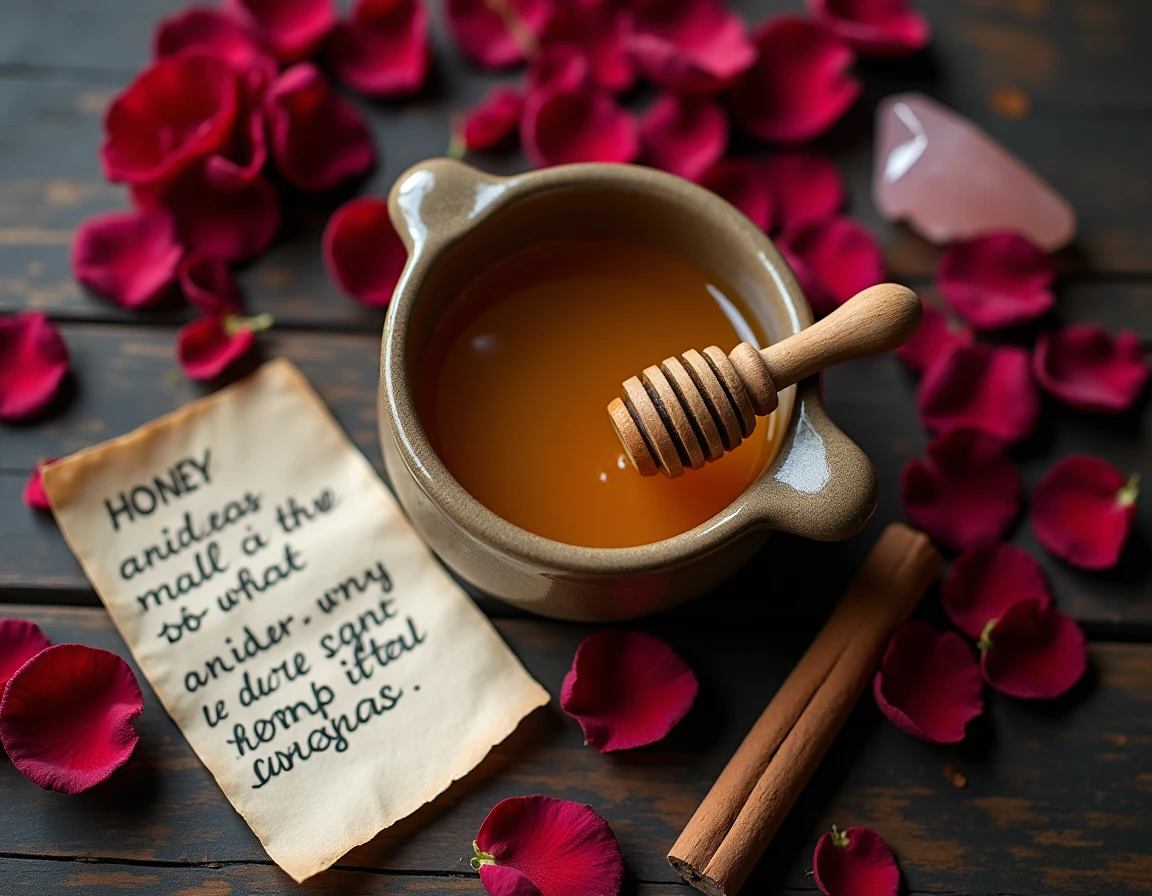
Each element of the ritual carries a precise symbolic charge. Confusing or neglecting them empties the practice of its internal coherence.
Honey as a Vector of Sweetness
In almost all recorded traditions, honey represents relational sweetness. It is not merely a repurposed food ingredient: honey embodies the softening of tensions and the opening of the heart. Its use in a love ritual aims to create an energy of positive attraction rather than coercion.
The Red Candle and Vital Energy
The candle, almost always red in these rituals, serves as an energetic catalyst. Its flame symbolizes life, passion, and transformation. In Afro-diasporic practices, it activates the intention set by the practitioner. In European white magic, it is sometimes combined with incense (rose or jasmine) to amplify the ritual’s atmosphere.
The Photo as an Anchor Point
The photo is not decorative. It serves as a focal support to direct the intention towards a specific person. In some rituals, two photos (one’s own and that of the targeted person) are placed face to face, linked by a red thread. Other practices place the photo in a jar with honey, sugar, and other ingredients.
Consent and Free Will: What Distinguishes an Ethical Ritual
A notable change marks recent practices. Several contemporary practitioners emphasize that the ritual should aim for the opening of the heart, not coercion over others. This distinction between the intention of harmony and an attempt at domination constitutes a clear dividing line.
The blog “guidanceamoureuse” specifies that the ritual with honey and photo should be oriented towards healing and harmony, not control. African practitioners of honey rituals also emphasize calming rather than pure enchantment.
Elements to check before engaging in such a ritual:
- The formulated intention respects the free will of the targeted person, without seeking to force a feeling
- The practitioner (if consulting one) explicitly speaks of mutual respect and not of a “guaranteed result”
- The ingredients used remain natural and symbolic (honey, candle, paper, thread), without harmful substances
- The ritual is presented as a work on oneself and one’s own energies, not as manipulation of others
This framework allows for distinguishing a sincere symbolic practice from a disguised attempt at control.
Preparing a Honey Love Ritual: Concrete Elements
For those wishing to explore this practice, sources converge on a common foundation of ingredients and gestures.
The basic materials include:
- A photo of the person towards whom one directs their intentions (some traditions also require one’s own photo)
- Natural honey, placed on the photo or in a closed container with it
- A red candle, lit during the ritual to symbolize energy and passion
- A red ribbon or thread to symbolically bind the two photos or wrap the whole
- Depending on the tradition, additions such as clove (to anchor the bond), sugar, sea salt, or essential oils of savory and rosemary
Lunar timing plays a role in some traditions: European white magic recommends practicing during the first or last quarter of the moon. Contemporary online practices do not mention this constraint, which simplifies access but may potentially alter the symbolic significance of the gesture.
The state of mind at the time of the ritual is mentioned in all sources as a determining condition. Concentration and clarity of intention matter as much as the ingredients themselves. A ritual performed in haste or doubt loses its symbolic coherence, regardless of the care taken with the material elements.
The honey love ritual with a photo sits at the intersection of ancient traditions and recent digital reappropriations. What makes it comprehensible is less the list of ingredients than the clarity of the intention set and the respect for the person towards whom this intention is directed.