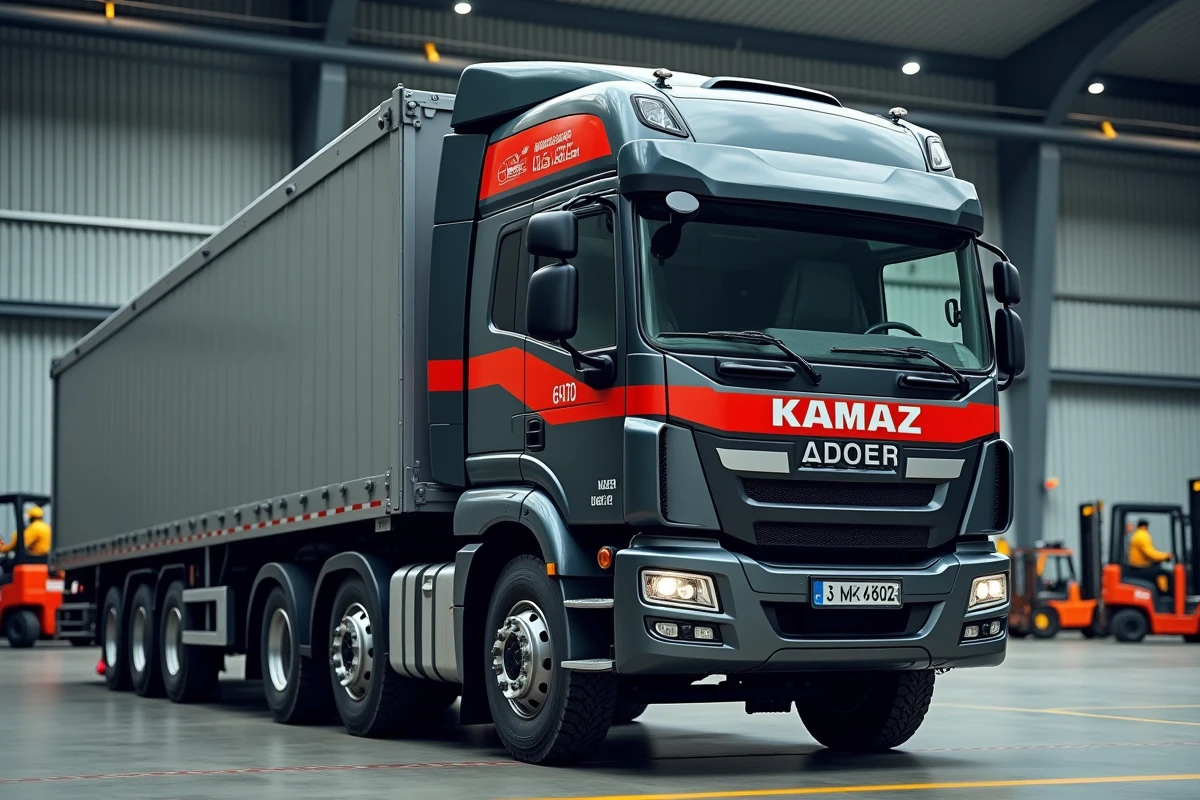
On a a mining site in Kazakhstan or a bumpy road in the Sahel, the choice of truck determines the entire logistics chain. When European and Japanese manufacturers withdraw from certain areas due to trade restrictions, a Russian manufacturer fills the vacant space. Kamaz takes advantage of this geographical repositioning to expand its range and test technologies that few French-speaking media cover in detail.
Kamaz Autonomous Trucks: Pilot Tests on Closed Industrial Sites
There is much talk about autonomous driving for passenger cars, but the most advanced use case at Kamaz concerns heavy vehicles in a controlled environment. Since 2023, Kamaz autonomous trucks have been operating on closed mining and logistics sites in Russia, in partnership with Russian digital players.
The principle is pragmatic. In a mining operation, the routes are repetitive, speeds are low, and third-party traffic is almost nonexistent. This context drastically reduces algorithmic complexity compared to an open highway. Advanced onboard telematics allows real-time monitoring of the vehicle’s mechanical condition, fuel consumption, and transported tonnage.
For fleet operators working in countries where skilled labor is lacking, this type of solution represents a concrete productivity lever. Feedback varies on this point depending on the site’s configuration, but the operational gain on short rotations seems real according to the manufacturer’s communications.
You can find business news about Kamaz directly related to these technological developments, documenting the progress of pilot programs and ongoing industrial partnerships.
Kamaz Export Markets: Africa, Middle East, and Central Asia
The partial withdrawal of European and Japanese brands from several markets has opened a commercial opportunity. Russian foreign trade reports published between 2023 and 2024 indicate a notable increase in Kamaz truck deliveries to the Middle East, Africa, and Central Asia.
In the Sahel, for example, Kamaz fleets are deployed for agricultural and goods transport uses. Price is a factor, but not the only one. The mechanical robustness of these vehicles, designed for extreme weather conditions, is a technical argument against Korean or Chinese competitors positioned in the same segment.
For companies looking to operate in these regions, the availability of spare parts and the presence of local maintenance networks remain decisive criteria. Kamaz is gradually structuring its after-sales service in several African countries, which differentiates its approach from a simple vehicle export.
- Middle East: growing demand for heavy utility vehicles for construction and oil logistics, with supply contracts signed in the last two years.
- Sub-Saharan Africa: deployment on national agricultural programs, particularly in the Sahel, where resistance to unpaved tracks is paramount.
- Central Asia: geographical proximity to Russia, reduced transport costs, and compatibility with existing road infrastructures.
Russian Industrial Policy and Kamaz’s Domestic Market Protection
The Russian government has implemented a massive support system for the production of national industrial vehicles between 2022 and 2024. Direct subsidies, priority public orders, and national preference in tenders form a triptych that directly benefits Kamaz.
This regulatory framework creates an environment of near-protection in the domestic market. Russian budget documents explicitly present this policy as a lever for import substitution. For Kamaz, this means a secured domestic order book, freeing up production capacity for export.
In practice, when observing the group’s strategy, the regulatory dimension is not just a favorable context. It structures the manufacturer’s profitability and its ability to invest in research, including on the autonomous vehicle projects mentioned earlier.
Special Vehicles by Kamaz: A Segment to Watch
Beyond conventional transport trucks, Kamaz is developing a range of special vehicles designed for specific uses:
- Construction machinery adapted for mining operations, with reinforced chassis to support heavy loads on rough terrain.
- Military utility vehicles converted for civil logistics applications in hard-to-access areas.
- Tankers and modular platforms for the oil and gas sector, segments where demand remains strong in producing countries.

This positioning in special vehicles allows Kamaz to capture markets with higher margins than standard road transport. Tenders in the mining or energy sector involve smaller volumes but with significantly higher unit prices.
For professionals following the industrial vehicle sector, Kamaz’s strategy illustrates how a manufacturer can transform geopolitical constraints into commercial repositioning. The combination of a protected domestic market and targeted expansion into non-aligned countries outlines an atypical economic model, far removed from the classic approaches of major European heavy-duty groups.